
Yoga Mudras: Meaning, Types and How to Practice
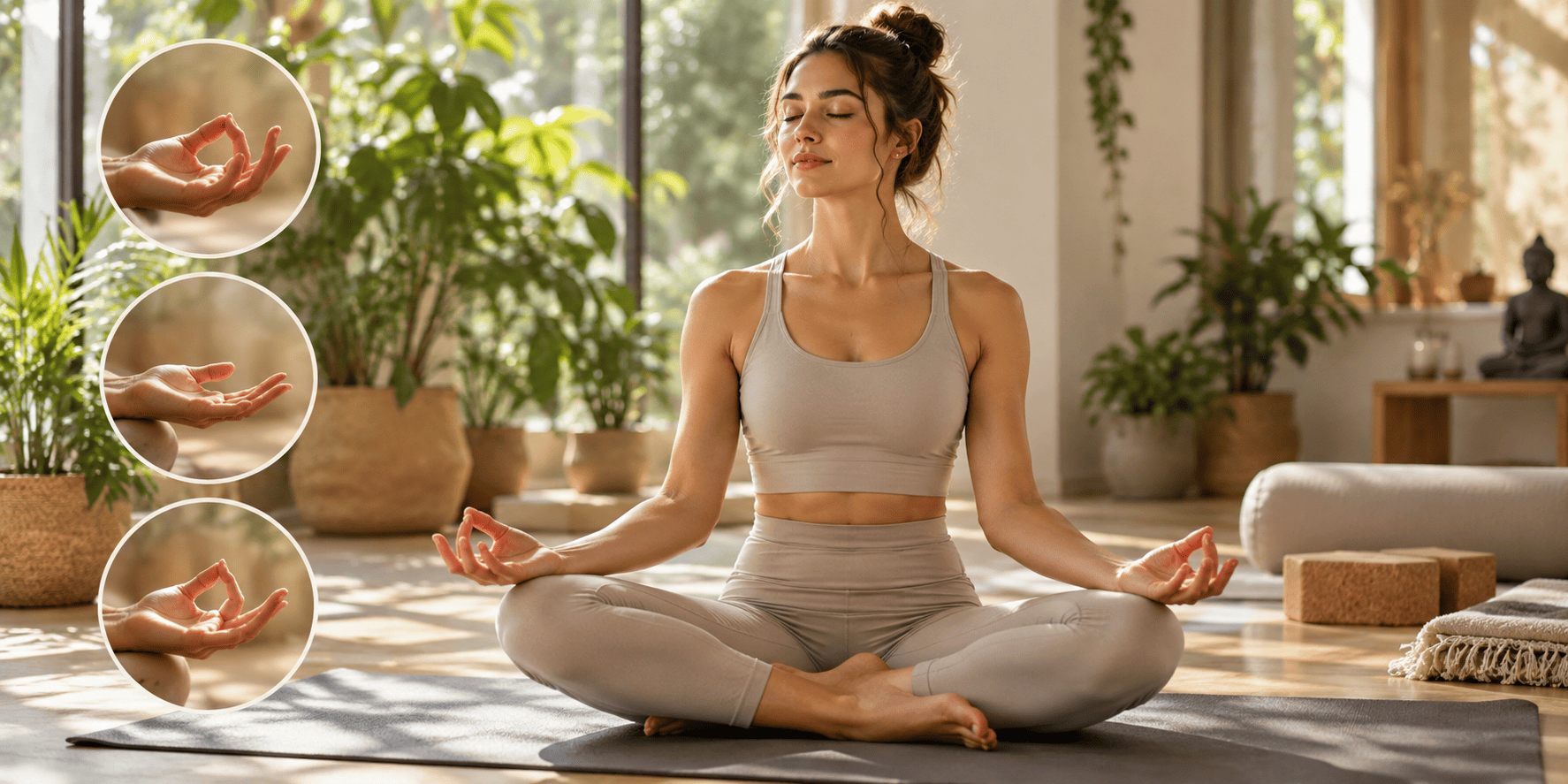
You may have seen someone meditating with the thumb and index finger touching, bringing the palms together at the heart, or arranging the hands in a more intricate shape during yoga. These gestures are called mudras.
Mudras have been used within yoga, meditation, Buddhism, Indian classical traditions, and other contemplative practices for centuries. Some are simple hand positions. Others involve the eyes, tongue, posture, or whole body.
For modern practitioners, mudras can offer something wonderfully practical: a physical point of focus. Instead of trying to force the mind into silence, you give the body a deliberate shape and allow attention, breath, and intention to meet there.
What Is a Mudra in Yoga?
The Sanskrit word mudra is commonly translated as “seal,” “gesture,” or “mark.” In yoga, a mudra is an intentional position used to support concentration, meditation, breath awareness, or a particular quality of practice.
Hand gestures are the most familiar form, but the yogic understanding of mudra is broader than hand positions alone.
Traditionally, mudras may be used alongside meditation, pranayama, mantra, visualization, or asana. In practices such as Kundalini yoga, mudras may appear as one part of a larger practice that combines breath, movement, sound, and focused awareness.
Mudras are not magic switches that guarantee a particular physical or emotional result. Their value is better understood as part of an intentional practice involving attention, symbolism, breath, and embodied awareness.
What Do Yoga Mudras Represent?
Different traditions explain mudras in different ways. Some connect individual fingers with elements, qualities of consciousness, planets, or subtle energy. Others emphasize their symbolic, devotional, or meditative purpose.
One widely used traditional framework associates the fingers with the five elements:
Thumb: fire
Index finger: air
Middle finger: space or ether
Ring finger: earth
Little finger: water
These associations belong to traditional yogic and Ayurvedic systems rather than modern anatomy. You do not need to accept a particular energetic explanation to practice a mudra.
A gesture can simply become an embodied reminder of the intention you bring to meditation.
What Are the Main Types of Mudras?
When people search for yoga mudras, they are usually looking for hand mudras, also called hasta mudras. Traditional yoga, however, describes several broader categories.
Hasta Mudras
Hasta means “hand.” These are gestures formed with the fingers and hands and include familiar practices such as Gyan Mudra, Anjali Mudra, and Dhyana Mudra.
They are often used during meditation, pranayama, chanting, or seated yoga practices.
Kaya Mudras
Kaya mudras involve the body rather than only the hands. They may combine posture, breath, awareness, and sometimes internal muscular engagement.
These practices are generally more complex than beginner hand mudras and are best approached with knowledgeable instruction.
Mana Mudras
Mana mudras involve the head, eyes, tongue, or sensory attention. Certain gazing practices and tongue positions used in traditional yoga fall into this category.
Because some techniques can be more intensive, beginners do not need to explore them before developing a comfortable foundation in breath and meditation.
Bandha and Adhara Mudras
Some traditional classifications also include practices connected with bandhas, or internal locks, and mudras involving the pelvic floor and lower body.
These are more advanced practices and should not be treated as interchangeable with simple hand gestures.
8 Common Yoga Mudras and Their Meanings
There are many mudras across yogic and contemplative traditions. You do not need to memorize dozens of them to begin.
These eight provide a useful foundation.
1. Anjali Mudra
Bring your palms together in front of the center of your chest with the fingers pointing upward.
Anjali Mudra is often associated with greeting, reverence, gratitude, balance, and connection. It is commonly practiced at the beginning or end of a yoga class and is sometimes paired with Namaste.
Rather than pressing the hands forcefully together, keep the gesture comfortable and allow the shoulders to remain relaxed.
2. Gyan Mudra
Touch the tip of the index finger to the tip of the thumb while allowing the other three fingers to extend naturally. Rest the backs of the hands on the thighs or knees.
Gyan Mudra is traditionally associated with knowledge, awareness, concentration, and meditation.
It is one of the mudras frequently encountered in Kundalini practices, where hand positions may accompany breathwork, mantra, and meditation. Yoga Farm's guide to Kundalini yoga techniques explores how these different elements can work together within a broader practice.
3. Chin Mudra
Chin Mudra looks very similar to Gyan Mudra. The thumb and index finger meet, but the palms typically face downward on the thighs.
Traditional interpretations sometimes distinguish the two according to the direction of the palms and their symbolic qualities.
For a beginner, the most useful distinction is practical. Notice whether palms facing up or down changes your sense of grounding, openness, or attention.
4. Dhyana Mudra
Place one hand inside the other in your lap with both palms facing upward. Allow the thumbs to touch lightly or remain close together.
Dhyana Mudra is strongly associated with meditation, stillness, and contemplation.
It works particularly well during seated meditation because the hands can rest naturally rather than requiring muscular effort.
5. Prana Mudra
Touch the thumb to the ring finger and little finger while keeping the index and middle fingers gently extended.
Traditional yoga associates Prana Mudra with prana, or vital life energy. Practitioners may use it when focusing on vitality, presence, or energetic awareness.
Approach these traditional meanings as part of yoga philosophy rather than as guaranteed physiological effects.
6. Apana Mudra
Bring the tips of the middle and ring fingers to the thumb while the index and little fingers remain extended.
Apana is traditionally associated with the downward moving aspect of prana and themes such as grounding, elimination, and release.
The gesture can also be used more simply as a point of concentration during quiet breathing.
7. Vishnu Mudra
Fold the index and middle fingers toward the palm while keeping the thumb, ring finger, and little finger available.
Vishnu Mudra is commonly used during alternate nostril breathing. The thumb and ring finger can gently control the nostrils as the breath alternates from side to side.
Because breathwork can affect people differently, keep the breathing relaxed and discontinue a technique if you feel dizzy, strained, or uncomfortable.
8. Hakini Mudra
Bring the fingertips of both hands together while keeping the palms slightly apart.
Hakini Mudra is often associated with concentration, integration, and mental focus. It can provide a simple tactile anchor when sitting quietly or preparing for meditation.
The gesture should remain light. There is no need to press the fingertips together forcefully.
How to Practice Yoga Mudras
You do not need a complicated ritual to use a mudra. A few quiet minutes can be enough to explore how the gesture affects your attention.
Choose a comfortable seated position on the floor or in a chair. You can also practice many hand mudras while standing or lying down.
Select one mudra and form it gently. Relax your shoulders, jaw, hands, and fingers.
Bring attention to your natural breathing. Rather than trying to immediately produce a particular result, notice what is already happening.
You might observe:
The sensation where your fingers touch
Changes in the rhythm of your breath
Areas of tension in the hands or shoulders
Thoughts that arise during stillness
Whether the gesture helps your attention feel steadier
Stay for several breaths or a few minutes. When you are ready, release your hands slowly and notice whether anything has shifted.
Mudras can also be incorporated into chakra meditation when you want to combine a physical gesture with breath, visualization, mantra, or awareness of different areas of the body.
How Long Should You Hold a Mudra?
There is no universal duration that applies to every mudra or every tradition.
For a simple meditation practice, beginners might hold one mudra for 3 to 10 minutes. Some traditional practices use mudras for longer periods, while others combine them with a specific number of breaths, repetitions of a mantra, or a structured kriya.
Comfort matters more than reaching an arbitrary number of minutes.
If your fingers become painful, numb, tense, or fatigued, release the gesture. A mudra should not become an endurance test.
When Should You Practice Mudras?
Mudras can be practiced at many points within yoga and meditation.
You might use one:
Before meditation to establish an intention
During pranayama to support the structure of the technique
While chanting or repeating a mantra
During a seated yoga posture
At the beginning or end of a class
During a quiet moment in your day
Consistency can be more useful than complexity. Choosing one simple mudra and practicing it regularly allows you to observe your own experience instead of constantly switching techniques.
Can Mudras Balance Chakras?
Mudras and chakras are sometimes paired within traditional yoga and contemporary energy practices. Particular gestures may be associated with particular elements, energetic qualities, or chakras.
These relationships belong to yogic subtle body traditions. They should not be confused with established medical anatomy.
If chakra language resonates with you, mudras can become one part of a meditation involving breath, sound, visualization, and mindful awareness. If it does not, you can still use the physical gesture as a concentration practice.
Both approaches can coexist without requiring exaggerated claims about what a hand position can do.
Using Mudras as a Yoga Teacher
For yoga teachers, mudras offer an opportunity to teach more than a shape.
Students benefit from understanding what a gesture means, where it comes from, how it relates to the practice being taught, and whether participation is optional.
Avoid presenting a particular mudra as a guaranteed cure for anxiety, illness, hormonal imbalance, trauma, or another health concern. Traditional energetic associations can be shared as tradition while being clearly distinguished from medical evidence.
Choice also matters.
A student with arthritis, nerve pain, an injury, limited hand mobility, or another physical consideration may not be able to form a textbook version of a mudra. The practice should support the student, not ask the student to force their body into a symbolic shape.
Yoga Farm Ithaca brings this same emphasis on choice, context, and nervous system awareness into its 200-hour Kundalini yoga teacher training. Mudra is explored as one part of a much larger teaching system that includes meditation, breath, mantra, movement, anatomy, ethics, and trauma-informed methodology.
Do Mudras Really Work?
The answer depends on what you expect a mudra to do.
Yoga traditions have long attributed energetic, spiritual, and symbolic effects to specific gestures. Modern scientific evidence for many highly specific claims about individual mudras remains limited.
That does not make the practice meaningless.
Holding an intentional hand position can provide tactile feedback, focus attention, support meditation, and create a physical ritual around a chosen intention. When mudras are combined with slow breathing and mindful awareness, it can also be difficult to separate the effect of the gesture from the effects of the entire contemplative practice.
A grounded approach allows tradition and curiosity to exist together.
You can explore the practice without requiring every traditional interpretation to become a scientific claim.
Bringing Mudras Into Your Practice
Mudras invite you to experience yoga through something remarkably small: the position of your hands.
That simplicity is part of their usefulness. You do not need advanced flexibility, elaborate equipment, or a long sequence. You need attention, breath, and enough time to notice your experience.
Begin with one gesture. Sit comfortably. Let your breathing settle. Notice what happens without demanding that something special happen.
Over time, a mudra may become familiar enough that simply bringing the hands into position signals an invitation to become present.
For those who want to move beyond individual techniques and understand how mudra fits within the broader traditions of posture, meditation, philosophy, breath, and mindful teaching, Yoga Farm's online yoga teacher training programs provide several paths for deeper study.
Frequently Asked Questions About Yoga Mudras
What Are Mudras in Yoga?
Mudras are intentional gestures used in yoga, meditation, and related contemplative traditions. Although hand mudras are the most familiar, traditional mudras can also involve the body, eyes, tongue, breath, or internal muscular actions.
Which Mudra Is Best for Beginners?
Gyan Mudra, Anjali Mudra, and Dhyana Mudra are approachable choices for beginners. They are simple to form and can be incorporated easily into meditation or breath awareness without requiring complex technique.
How Many Yoga Mudras Are There?
There is no single universally accepted number. Different yogic, Buddhist, tantric, classical dance, and spiritual traditions describe different systems and collections of mudras. For everyday yoga practice, it is more useful to understand a few gestures well than to memorize a large list.
Can I Practice Mudras Every Day?
Simple hand mudras can generally be incorporated into a daily meditation or yoga practice when they feel comfortable. Avoid forcing your fingers or maintaining a position that causes pain, numbness, or strain.
Do Mudras Have to Be Practiced While Meditating?
No. Many mudras are used during meditation, but they can also accompany pranayama, mantra, yoga postures, chanting, or other contemplative practices. Some people also use a simple mudra for a few moments during the day as a reminder to return to their breath.
Do You Have to Use Both Hands for a Mudra?
It depends on the mudra. Many hand mudras are practiced symmetrically with both hands, while others have specific roles for the right and left hands. Follow the instructions for the particular gesture you are exploring, while adapting when needed for accessibility.
What Is the Difference Between a Mudra and a Mantra?
A mudra is a physical gesture or seal, while a mantra is a sound, word, or phrase used in meditation or spiritual practice. Some yoga traditions combine mudra and mantra so the body, voice, breath, and attention participate together.
Can Yoga Teachers Use Mudras in Class?
Yes. Yoga teachers can incorporate mudras when they understand the gesture, provide appropriate cultural and philosophical context, and make participation optional. Teachers should also offer adaptations for students who cannot comfortably form a particular hand position.