Qigong vs. Tai Chi: What Is the Difference?
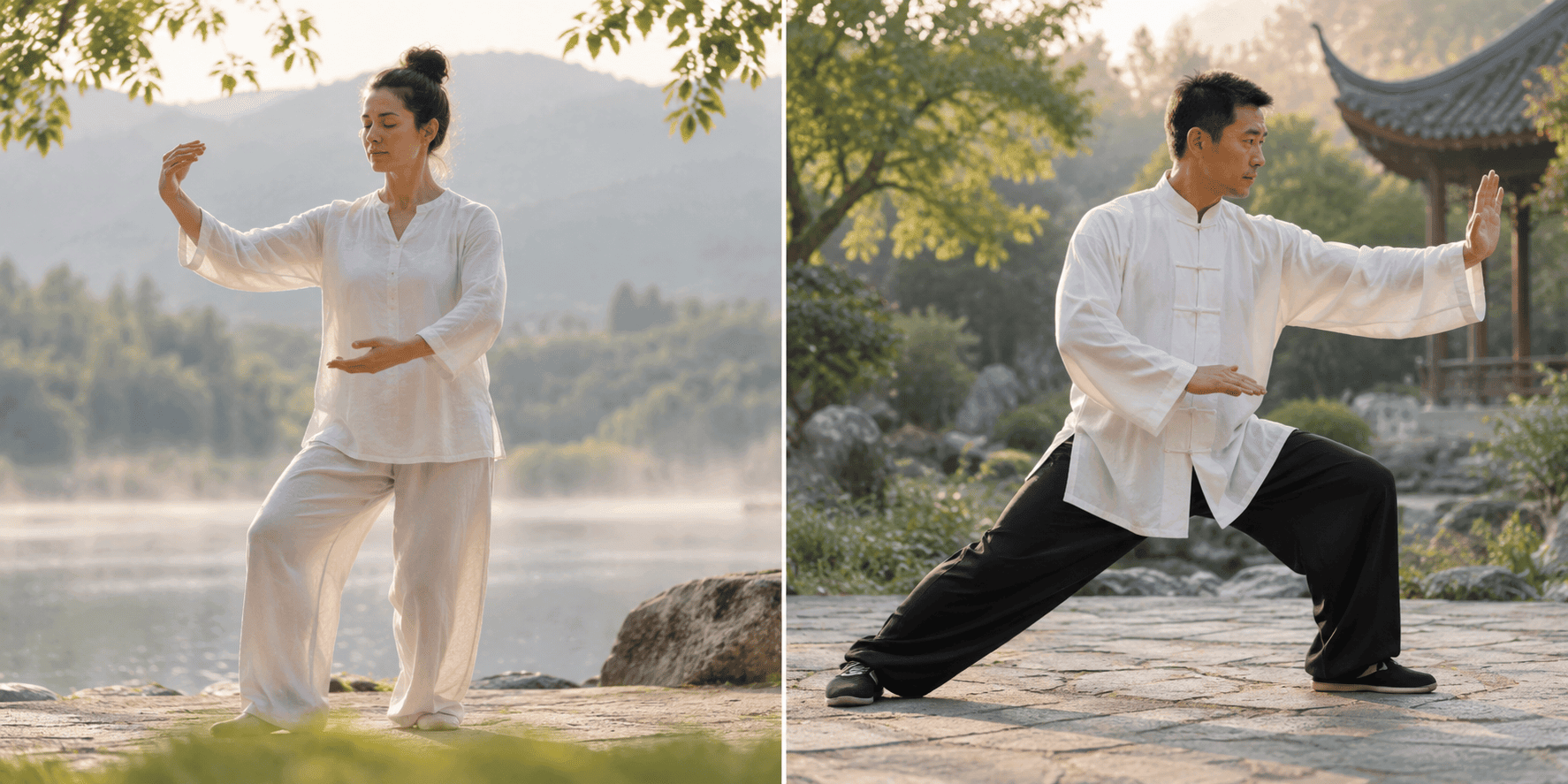
Qigong and Tai Chi can look remarkably similar from across a room. Both may involve slow, flowing movements, focused breathing, upright posture, and a sense of calm attention. Yet these practices are not simply two names for the same thing.
Qigong is a broad family of Chinese mind and body practices that may use movement, stillness, breathing, posture, and focused attention. Tai Chi, also called Taijiquan or Tai Chi Chuan, developed as a Chinese martial art and is commonly practiced through connected sequences of movements known as forms.
For many beginners, Qigong is easier to enter because individual movements can be repeated without memorizing a long sequence. Tai Chi often asks for more attention to footwork, weight shifting, transitions, and choreography. Neither is inherently better. The right practice depends on what draws you in.
What Is Qigong?
Qigong, pronounced “chee-gung,” is a broad term for practices that cultivate a relationship between posture, movement, breathing, awareness, and the traditional Chinese concept of qi.
Some Qigong practices are flowing and rhythmic. Others involve standing quietly, sitting, breathing, or repeating one movement for several minutes. This variety is one reason Qigong can meet people at many different levels of mobility and experience.
Traditional Qigong has connections with Chinese medicine, Taoist and Buddhist traditions, martial arts, meditation, and Chinese philosophy. Rather than being one single system, it includes many lineages and approaches.
A foundational practice often begins with posture, breathing, focused intention, and coordinated movement. Yoga Farm's free Qigong 101 uses those foundations alongside the Six Harmonies and Wave Hands Like Clouds, offering a concrete example of what an introductory Qigong practice can include.
Other approaches organize practice around particular frameworks. Five Element Qigong, for example, connects movement with the Wood, Fire, Earth, Metal, and Water framework used within Traditional Chinese Medicine.
What Is Tai Chi?
Tai Chi is a Chinese martial art often recognized today for its slow, continuous movement. A Tai Chi form connects individual postures through carefully coordinated transitions, turns, steps, and changes in weight.
There are several major styles of Tai Chi, including Yang, Chen, Wu, and Sun. Each has its own characteristics, but all involve more than simply moving slowly. Alignment, balance, timing, coordination, attention, and martial principles can all be part of the practice.
Many people today practice Tai Chi primarily for movement, meditation, balance, or general wellbeing rather than martial applications. Its martial history, however, remains an important part of what distinguishes it from the much broader category of Qigong.
Are Qigong And Tai Chi The Same Thing?
Qigong and Tai Chi overlap considerably, which is why the distinction can become confusing.
Both use intentional movement, posture, breathing, attention, and internal awareness. Tai Chi practiced for health can even be understood within the broader family of Qigong practices. Still, Tai Chi also has its own history, forms, techniques, and martial framework.
A useful way to think about the relationship is that Qigong describes a very broad field, while Tai Chi describes a more specific tradition within Chinese movement arts.
That does not make Qigong basic or Tai Chi advanced. Both can become lifelong practices with considerable depth.
What Do Qigong And Tai Chi Have In Common?
The similarities are meaningful. Both traditions invite you to pay closer attention to how your body moves rather than simply trying to move harder or faster.
They commonly involve relaxed but intentional posture, conscious breathing, coordinated movement, focused awareness, and steady practice. Neither requires the intensity associated with many modern exercise programs.
Both can also become meditative. The repetition of movement, attention to the breath, and reduction of unnecessary muscular tension may create a different quality of awareness than exercise performed primarily for speed or performance.
The Main Differences Between Qigong And Tai Chi
Understanding the differences becomes easier when you consider what actually happens during a practice session.
Movement And Structure
Qigong frequently uses individual exercises that are repeated several times. A practice could include one standing posture, a breathing method, several repeated movements, and a short sequence.
Tai Chi usually connects movements into a form. Rather than repeating a single gesture many times, you gradually memorize how one posture flows into the next.
Martial Arts Origins
Tai Chi developed as a martial art. Even when someone practices only for health or meditation today, concepts such as rooting, balance, redirection, weight transfer, and coordinated whole body movement come from that martial heritage.
Qigong is broader. Some Qigong systems have close relationships with martial arts, while others developed primarily around meditation, health practices, spiritual cultivation, or Chinese medicine traditions.
Breathing And Attention
Breathing matters in both practices, but many Qigong systems make breath training especially explicit.
A Qigong session might intentionally explore abdominal breathing, movement coordinated with inhaling and exhaling, or quiet breathing during standing meditation. Tai Chi breathing is also important, but it is commonly integrated into the continuous movement of the form.
Learning Curve
Qigong can provide a relatively simple entry point because you do not necessarily need to memorize an extended sequence before experiencing the practice.
Tai Chi often takes longer to become familiar because students are learning foot placement, direction, transitions, posture, and the order of a form at the same time.
Qigong's accessibility does not make it shallow. More advanced study can include Chinese energetic anatomy, standing practices, traditional sets, meditation, movement principles, and progressively subtler coordination of attention, breath, and body.
Qigong vs. Tai Chi Benefits
Both Qigong and Tai Chi have been studied as gentle mind and body practices, although research varies considerably according to the style practiced, the population being studied, and the length of the program.
Tai Chi has received substantial attention for balance and fall prevention, particularly among older adults. Research into Qigong has explored areas such as balance, movement, stress, quality of life, and general wellbeing. Neither practice should be presented as a guaranteed treatment for a medical condition.
Their practical value can also be simpler than a list of health claims. Both encourage regular movement, attention, coordination, breathing, and body awareness in ways that many people find sustainable.
Qigong vs. Tai Chi For Beginners
A beginner does not need to decide which practice is objectively better. Consider which type of experience sounds easier to return to consistently.
Qigong may suit you if you prefer:
Shorter or repeated movement patterns
Standing or seated options
More explicit breath practices
Less choreography at the beginning
A practice that can fit into a small space
Tai Chi may suit you if you prefer:
Flowing, connected movement sequences
Progressive forms to memorize and refine
More stepping and weight shifting
A strong connection with Chinese martial arts
Practicing coordination through longer sequences
You can also practice both. Qigong is frequently used alongside other movement and contemplative traditions rather than as an either or choice.
Qigong vs. Tai Chi For Older Adults And Limited Mobility
Both practices are commonly considered low impact, but accessibility depends on the individual teacher, style, class, and student's needs.
Qigong can be particularly adaptable because many exercises are performed in one place and some can be practiced seated. This may appeal to people who have difficulty moving up and down from the floor or who want a gentle movement practice without needing a mat.
Tai Chi can also be modified, although traditional forms generally involve more stepping, turning, and continuous weight transfer. For some students, that makes Tai Chi an appealing way to work with balance and coordination. For others, a more stationary Qigong practice may feel more accessible.
Anyone managing significant balance difficulties, injury, pain, or a medical condition should choose instruction appropriate to their individual needs.
Can You Practice Qigong And Tai Chi Together?
Yes. There is no need to treat Qigong and Tai Chi as competing systems.
A Tai Chi practitioner might use Qigong to settle the breath, explore standing posture, or prepare the body before practicing a form. Someone who begins with Qigong may later become interested in Tai Chi because they enjoy coordinated movement and want to explore longer sequences.
The practices can inform one another while still maintaining their distinct traditions.
Qigong vs. Tai Chi vs. Yoga
Yoga adds another tradition that can look similar from the outside while coming from a very different historical and philosophical context.
Yoga developed within South Asian traditions and includes far more than physical postures. Depending on the school, it may incorporate movement, breathwork, meditation, philosophy, ethics, mantra, and contemplative practice.
Qigong emerged within Chinese traditions and often centers on posture, breath, movement, awareness, and concepts drawn from Chinese philosophy and medicine. Tai Chi is a Chinese martial art practiced through linked forms.
The internal attention found in Qigong can also feel familiar to people interested in somatic yoga, where the emphasis shifts from performing a shape correctly toward noticing sensation, movement, choice, and the body's response from within.
There are areas of overlap among these practices, but treating all three as interchangeable forms of “mindful movement” misses the histories and methods that make each tradition meaningful.
What Does A Beginner Qigong Practice Look Like?
A beginner Qigong session does not need to contain a complicated sequence.
You might begin by finding a comfortable standing or seated posture and noticing your breathing. From there, the teacher may introduce one or two movements that are repeated slowly, giving you time to notice alignment, balance, tension, and coordination.
A practice may then move into a short set before finishing with stillness or quiet attention. Over time, familiar movements can become opportunities to notice increasingly subtle relationships between posture, breath, movement, and awareness.
The emphasis is not on performing more movements. It is on becoming more present within the ones you are already practicing.
From Personal Qigong Practice To Deeper Study
Some people are content to keep Qigong as a personal daily practice. Others become curious about why particular movements are taught, how practices are sequenced, or how to guide another person responsibly.
That transition involves more than knowing the movements. Becoming a Qigong instructor adds skills such as clear cueing, adapting movement, sequencing a class, supporting beginners, ethical teaching, and understanding the difference between personal practice and responsibility for students.
Yoga Farm's Qigong education follows that same progression. Practice comes first. Deeper theory and teaching skills can follow when a student feels ready for them.
Frequently Asked Questions
Is Qigong The Same As Tai Chi?
No. Qigong is a broad family of Chinese practices involving movement or stillness, posture, breathing, and focused attention. Tai Chi is a specific Chinese martial art typically practiced through connected sequences called forms. They share important principles, but they are not identical.
Is Tai Chi A Form Of Qigong?
Tai Chi practiced as a mind and body health practice can be considered part of the broader Qigong family. Tai Chi also remains a distinct martial art with its own forms, techniques, history, and traditions.
Is Qigong Easier Than Tai Chi?
Qigong is often easier to begin because many practices involve repeating individual movements rather than memorizing a long sequence. Both Qigong and Tai Chi can become increasingly sophisticated with years of practice.
Which Is Better For Beginners, Qigong Or Tai Chi?
Qigong may feel more approachable if you prefer simple repeated movements, breathing practices, or stationary exercises. Tai Chi may be a better fit if you enjoy flowing sequences, coordination, footwork, and progressively memorizing forms.
Which Is Better For Seniors, Qigong Or Tai Chi?
Both can be suitable for older adults when taught appropriately. Qigong may be easier to adapt for seated or stationary practice, while Tai Chi often involves more weight shifting and stepping. Individual balance, mobility, health, and personal preference matter more than age alone.
Can You Practice Qigong Sitting Down?
Many Qigong practices can be adapted to a chair or seated position. This makes certain forms of Qigong particularly approachable for people who prefer not to stand for long periods or have limited mobility.
Can You Practice Qigong And Tai Chi Together?
Yes. The practices can complement one another. Qigong may be used for breathing, standing practice, or preparation, while Tai Chi provides a structured way to explore continuous movement, balance, and coordinated forms.