
Four Paths Of Yoga: Karma, Bhakti, Jnana And Raja Explained
Yoga is often introduced through physical postures, but asana represents only one part of a much wider tradition. Across yogic philosophy, practice can also take the form of serving others, cultivating devotion, studying the nature of the self, or training the mind through meditation.
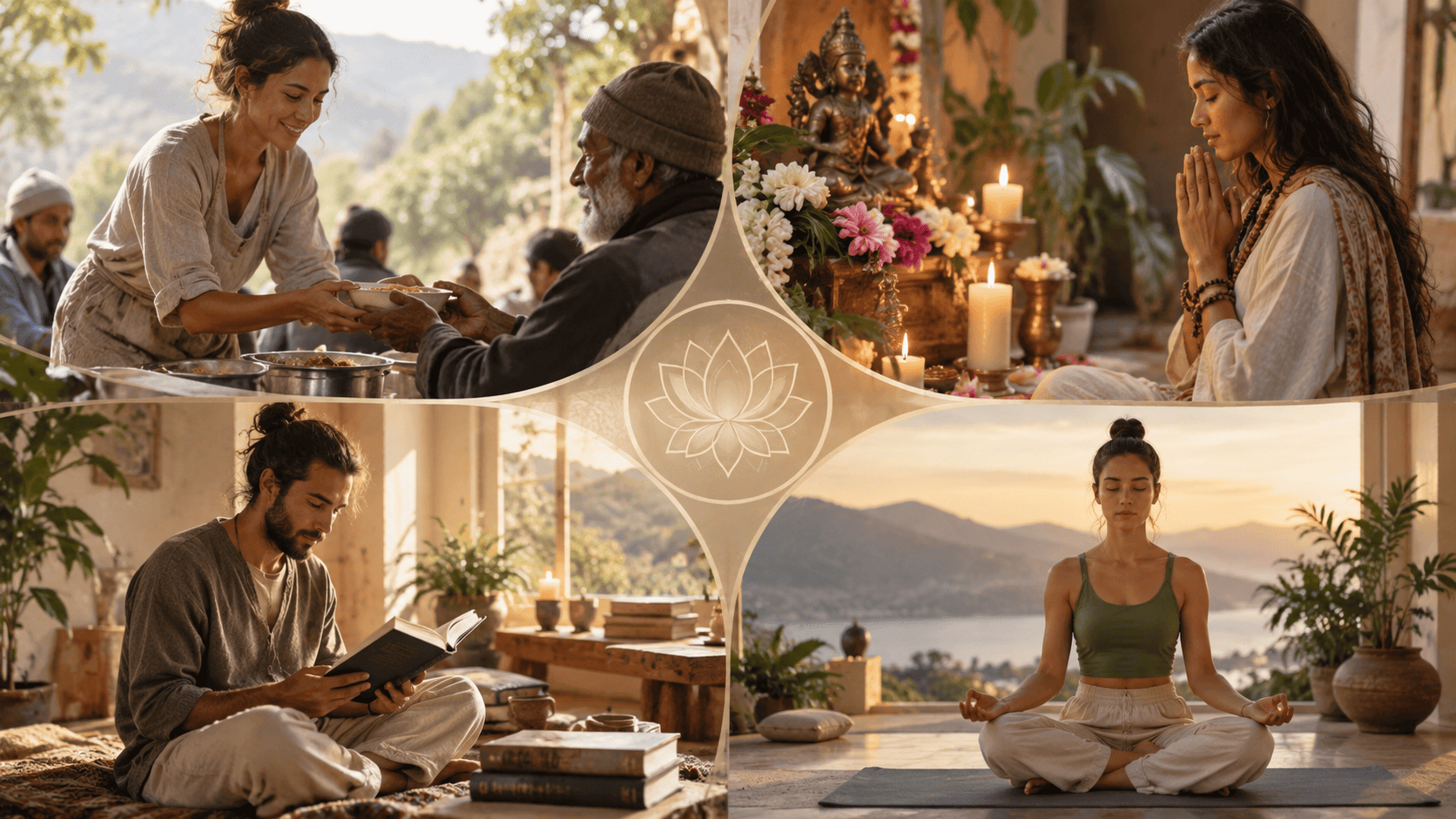
The four commonly taught paths of yoga are Karma Yoga, the path of action; Bhakti Yoga, the path of devotion; Jnana Yoga, the path of knowledge; and Raja Yoga, the path of meditation and mental discipline. Each offers a different doorway into the larger purpose of yoga.
Rather than competing with one another, these paths can support different personalities, seasons of life, and ways of connecting with practice.
What Are The Four Paths Of Yoga?
The four paths describe broad approaches to spiritual practice rather than styles of physical yoga. They help explain how different people may move toward greater awareness, freedom, connection, and self-understanding.
Karma Yoga: selfless action and service without attachment to reward
Bhakti Yoga: devotion, love, surrender, mantra, and sacred relationship
Jnana Yoga: wisdom, contemplation, discernment, and self-inquiry
Raja Yoga: meditation, concentration, ethical discipline, and mastery of the mind
A person does not have to choose only one. Many practitioners naturally move between all four throughout a day or lifetime.
Where Do The Four Paths Of Yoga Come From?
The ideas behind these paths developed within India's rich philosophical and spiritual traditions. Teachings related to action, devotion, knowledge, and meditation can be found across texts including the Bhagavad Gita and the Upanishads.
The familiar grouping of Karma, Bhakti, Jnana, and Raja Yoga was later brought together and presented to modern audiences through teachers including Swami Vivekananda.
The Four Paths And The Bhagavad Gita
The Bhagavad Gita takes place as a conversation between Krishna and the warrior Arjuna, who is struggling with responsibility, identity, duty, and right action.
Throughout the text, Krishna explores several approaches to yoga. These include acting without attachment to personal reward, developing devotion, cultivating wisdom, and disciplining the mind through meditation.
The Gita does not present yoga as withdrawal from ordinary life. Instead, much of its teaching asks how spiritual understanding can shape the way a person acts within the world.
Karma Yoga: The Path Of Selfless Action
Karma means action. Karma Yoga focuses on how we participate in life, particularly how we perform our responsibilities without becoming completely attached to praise, recognition, success, or a particular result.
A central idea is acting skillfully because the action itself is worthwhile. The emphasis shifts from "What will I receive?" toward "How can I participate with integrity?"
Karma Yoga is closely associated with seva, or selfless service. Yet it does not require joining a nonprofit or dedicating every waking hour to volunteering. Caring for family, doing thoughtful work, supporting a neighbor, or contributing to a community can all become practices of Karma Yoga when approached consciously.
Practicing Karma Yoga In Everyday Life
Karma Yoga may look remarkably ordinary.
You might complete your work carefully without needing recognition, help someone without expecting repayment, or contribute your skills to a community project. The practice involves noticing the desire for approval or control while continuing to act with care.
Yoga Farm's nonprofit mission similarly connects personal practice withcommunity service, accessibility, and reducing financial and cultural barriers to healing practices.
Karma Yoga does not mean ignoring your own boundaries. Selfless action is different from abandoning your wellbeing or believing you must always say yes.
Bhakti Yoga: The Path Of Devotion
Bhakti Yoga approaches practice through the heart. It centers love, devotion, surrender, gratitude, and relationship with something experienced as sacred.
Traditional Bhakti practices can include chanting, mantra repetition, prayer, kirtan, ritual, and contemplation. Different traditions understand the object of devotion differently, so Bhakti does not have to look identical for every practitioner.
Someone may experience devotion through a relationship with a deity, while another person may encounter the sacred through nature, community, music, service, or a sense of connection larger than the individual self.
Practicing Bhakti Yoga
Bhakti can be practiced through singing mantra, creating a gratitude ritual, offering prayer, or bringing loving attention to daily activities.
The point is not emotional intensity for its own sake. Bhakti invites us to soften some of the constant effort to control experience and develop a more intimate relationship with reverence, trust, and connection.
Practices such as mantra, meditation, breathwork, and spiritual inquiry are also woven into Yoga Farm'sKundalini teacher training, where they are taught within a modern, inclusive, trauma-informed framework.
Jnana Yoga: The Path Of Knowledge
Jnana Yoga is sometimes called the path of wisdom or knowledge, but it involves much more than reading philosophy books.
Its central practice is inquiry into the nature of the self and reality. Instead of automatically believing every thought, identity, or assumption, the practitioner begins questioning what is temporary and what is fundamental.
Questions such as "Who am I?" become tools for investigation rather than questions that need an immediate intellectual answer.
Concepts associated with Jnana Yoga include viveka, or discernment, as well as teachings about Atman, Brahman, and the distinction between enduring reality and changing experience.
Practicing Jnana Yoga In Daily Life
Studying philosophical texts is one form of Jnana practice, but contemplation must eventually become experiential.
You might notice how strongly you identify with a role, opinion, achievement, or emotion and then ask whether that experience represents the whole of who you are.
Yoga philosophy can become especially useful when it moves from abstraction into daily decisions. Yoga Farm's exploration of the Eight Limbs of Yoga similarly looks beyond poses to consider ethics, attention, meditation, and how yogic teachings can influence everyday life.
Raja Yoga: The Path Of Meditation
Raja Yoga is commonly described as the path of meditation and mental discipline. Its practices work with attention, concentration, breath, ethical conduct, and awareness of the mind.
Raja Yoga is frequently associated with Patanjali's Yoga Sutras and the system known as the Eight Limbs of Yoga.
These eight limbs are:
Yama
Niyama
Asana
Pranayama
Pratyahara
Dharana
Dhyana
Samadhi
Asana appears within this system, but it is only one limb. Meditation, concentration, ethical principles, breath regulation, and sensory awareness are equally important parts of the larger path.
Practicing Raja Yoga
A Raja Yoga practice might begin with ten quiet minutes of meditation each morning. It could also include pranayama, concentration exercises, reflective study of the yamas and niyamas, or mindful asana.
This broader understanding of practice is reflected in Yoga Farm’s online yoga teacher training, where movement is studied alongside meditation, philosophy, breathwork, ethics, teaching skills, and personal inquiry.
Four Paths Of Yoga Vs Modern Yoga Styles
The four paths should not be confused with styles such as Hatha, Vinyasa, Yin, Restorative, Kundalini, or Ashtanga Vinyasa yoga.
Modern yoga styles usually describe particular approaches to movement, sequencing, energetics, or practice methodology. The four paths describe broader philosophical orientations toward yoga.
A single yoga class can contain several paths at once. Meditation may reflect Raja Yoga, studying philosophy can support Jnana Yoga, chanting may express Bhakti Yoga, and participating in community service can become Karma Yoga.
Even a posture practice can take on qualities of different paths depending on the intention behind it.
The Four Paths And The Eight Limbs Of Yoga
The four paths and the eight limbs are related, but they are not interchangeable systems.
The four paths describe broad approaches to yogic realization through action, devotion, wisdom, and meditation. The eight limbs describe a structured framework associated with Patanjali that moves through ethics, physical practice, breath, sensory awareness, concentration, meditation, and samadhi.
Raja Yoga is the path most commonly connected with the eight-limb system.
Do You Have To Choose One Path Of Yoga?
No. Human beings rarely fit neatly into a single category, and yoga does not require us to reduce ourselves to one temperament.
You may feel strongly drawn to meditation during one period of your life and to service during another. Study may deepen your understanding, while devotional practice may help you experience ideas that intellectual analysis cannot reach.
The paths can also appear naturally within one day.
Morning meditation might express Raja Yoga. Thoughtful work may become Karma Yoga. An evening spent studying philosophy can support Jnana Yoga, while chanting or gratitude may open into Bhakti Yoga.
Which Path Of Yoga Is Right For You?
Your natural tendencies can offer clues, but they do not need to become labels.
People who enjoy activity, contribution, and helping others may feel drawn toward Karma Yoga. Those who connect deeply through music, ritual, prayer, or heartfelt relationship may resonate with Bhakti Yoga.
Analytical and philosophical practitioners often appreciate Jnana Yoga, while people who value meditation, consistency, and structured inner practice may gravitate toward Raja Yoga.
The more useful question may be less about choosing the correct path and more about noticing which dimensions of practice are currently asking for your attention.
Bringing The Four Paths Into A Modern Yoga Practice
Yoga becomes wider when it is not reduced to what happens on a mat.
Movement can help us become more embodied. Meditation trains our ability to observe. Philosophy gives us questions worth living with. Devotion can soften our relationship with ourselves and others. Service asks us to consider how practice influences the world beyond our individual experience.
Yoga Farm’s Radiant Warrior training brings many of these dimensions together through Hatha and Vinyasa practice, mindfulness, philosophy, breathwork, inclusive teaching, and trauma-informed education.
The goal is not to collect as many practices as possible. It is to discover how practice can become integrated into the way we live.
The Four Paths Lead Toward A Shared Purpose
Karma, Bhakti, Jnana, and Raja Yoga begin from different places, but they point toward a shared possibility: living with greater awareness of ourselves, our relationships, and our place within something larger.
One person may arrive through meditation, another through service, another through devotion, and another through questioning. Most of us will probably encounter all four.
Yoga does not need every practitioner to follow the same road. The four paths remind us that meaningful practice can begin wherever we genuinely are.
Frequently Asked Questions
What Are The Four Main Types Of Yoga?
When people refer to the four classical or philosophical paths of yoga, they usually mean Karma Yoga, Bhakti Yoga, Jnana Yoga, and Raja Yoga. These are different from modern physical styles such as Hatha, Vinyasa, Yin, and Restorative Yoga.
What Are The Four Stages Of Yoga?
The "four stages of yoga" are not the same as the four paths. Some traditional texts describe progressive stages known as Arambha, Ghata, Parichaya, and Nishpatti, although terminology and interpretation vary between traditions.
What Are The Four Pillars Of Yoga?
There is no universally accepted set of teachings called the four pillars of yoga. Different schools use the phrase in different ways, so it should not automatically be treated as another name for Karma, Bhakti, Jnana, and Raja Yoga.
What Is The Hardest Path Of Yoga?
There is no objectively hardest path. Jnana Yoga can be demanding because it requires sustained self-inquiry and discernment, while Raja Yoga requires consistency and mental discipline. A path may feel easier or harder depending on a person's temperament and experience.
Can You Practice All Four Paths Of Yoga?
Yes. The four paths can complement one another. A practitioner may meditate through Raja Yoga, study philosophy through Jnana Yoga, practice devotion through Bhakti Yoga, and express yoga through service as Karma Yoga.
Is Hatha Yoga One Of The Four Paths?
No. Hatha Yoga is a distinct yoga tradition strongly associated today with physical postures, breath, and embodied practices. The commonly taught four philosophical paths are Karma, Bhakti, Jnana, and Raja Yoga.