
12 Best Yoga Poses For Building Core Strength
A strong core does much more than create toned abdominal muscles. Your core helps stabilize your spine and pelvis, supports balance, transfers force between your upper and lower body, and gives you control as you move through everyday life.
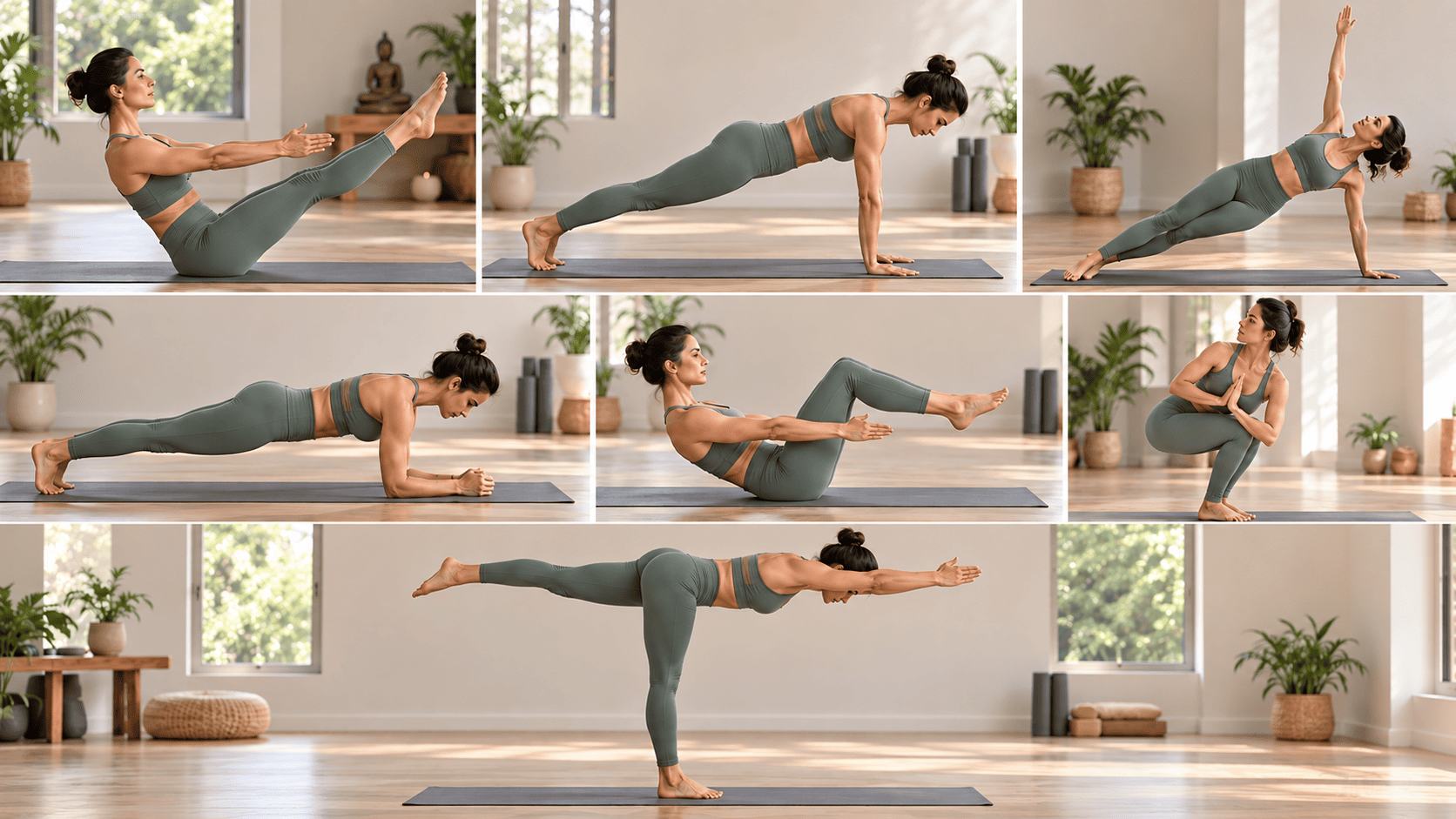
Yoga can build this kind of functional core strength without relying on endless crunches. Poses such as Boat, Plank, Side Plank, Bird Dog, Locust, and Warrior III ask your trunk to stabilize your body against gravity while you breathe and move with control.
The best yoga poses for core strength also work different parts of the midsection. Some challenge the front of the abdomen, others recruit the obliques and deep stabilizers, and poses such as Locust strengthen the back side of the core.
What Does Core Strength Actually Mean?
Your core is not just your rectus abdominis, the muscle commonly associated with visible abs. Think of it more like a supportive cylinder around the center of your body.
That system includes the transverse abdominis, internal and external obliques, spinal stabilizers such as the multifidus and erector spinae, the diaphragm, pelvic floor, and muscles surrounding the hips and pelvis. The glutes and hip stabilizers also contribute to many movements that require trunk control.
A strong core helps you resist unwanted movement as much as it helps you create movement. That is why balance poses, asymmetrical postures, Planks, and slow transitions can be just as valuable as exercises that involve bending the torso.
How Does Yoga Build Core Strength?
Yoga strengthens your core by repeatedly asking your body to stabilize itself in different relationships to gravity.
In Plank Pose, the abdominal muscles help prevent the hips from sagging. In Side Plank, the obliques work to keep the body lifted. In Warrior III, the trunk stabilizes the pelvis while one leg reaches behind you. Bird Dog teaches the body to resist rotation while opposite limbs move away from the center.
Flowing practices add another challenge because the core has to remain active while the body changes position. This is one reason Vinyasa yoga can develop strength through both individual poses and the controlled transitions between them.
The goal is not to brace as hard as possible. Good core work combines muscular support with breathing, coordination, alignment, and enough ease to remain aware of what the rest of your body is doing.
12 Best Yoga Poses For Core Strength
You do not need to practice every pose in one session. Start with positions you can perform with steady breathing and controlled alignment, then gradually increase the challenge.
1. Boat Pose
Boat Pose, or Navasana, is one of yoga's most recognizable core-strengthening postures. You balance on your sitting bones while your legs lift and your torso stays long, creating a V shape.
Boat strongly engages the rectus abdominis and deeper abdominal muscles while also asking the hip flexors to work. Instead of letting the chest collapse, think about lifting through the sternum while keeping the lower abdomen gently active.
Beginner option: Keep your knees bent and shins parallel to the floor. You can also lightly hold behind your thighs.
Progression: Straighten the legs or slowly lower your torso and legs closer to the floor before returning to Boat.
2. Plank Pose
Plank Pose, or Phalakasana, develops full-body stability while placing significant demand on the core.
From hands and knees, step your feet back until your body forms a long line from your head through your heels. Press through the floor, engage your legs, and gently draw the front ribs toward the pelvis without rounding the upper back.
Your transverse abdominis, rectus abdominis, obliques, glutes, shoulders, and back all contribute to maintaining the position.
Beginner option: Lower your knees while maintaining a long line from the knees through the crown of the head.
3. Side Plank
Side Plank, or Vasisthasana, shifts the challenge toward the lateral core. The obliques work to keep your hips lifted while the supporting shoulder and outer hip help stabilize the pose.
From Plank, shift your weight into one hand and rotate onto the outer edge of one foot. Stack or stagger the feet and lift the opposite arm.
Beginner option: Bring your bottom knee to the mat.
As you become stronger, work toward keeping the hips stacked rather than letting them rotate toward the floor.
4. Bird Dog
Bird Dog, often called Balancing Table in yoga classes, is an excellent choice for beginners because it trains stability without placing as much weight through the wrists and shoulders as Plank.
Begin on hands and knees. Extend your right leg behind you and your left arm forward while keeping your pelvis level. Imagine balancing a glass of water across your lower back.
The transverse abdominis, multifidus, glutes, shoulders, and other deep stabilizers work together to prevent the torso from twisting.
Move slowly and switch sides rather than trying to lift the arm or leg as high as possible.
5. Forearm Plank
Forearm Plank provides many of the same benefits as Plank while changing the relationship between your shoulders, arms, and trunk.
Place your forearms on the mat with your elbows approximately beneath your shoulders. Step your feet back and create a long line through your body.
Press the forearms into the floor, engage the thighs and glutes, and keep the abdomen active enough to prevent excessive arching through the lower back.
Try holding the pose for several steady breaths rather than staying until your alignment begins to collapse.
6. Dolphin Pose
Dolphin Pose strengthens the shoulders and upper body while asking the abdominals and back muscles to stabilize the trunk.
Begin on your forearms and lift your hips upward, similar to Downward-Facing Dog. Keep pressing the forearms into the mat while lengthening through the spine.
For a stronger core challenge, slowly move between Dolphin and Forearm Plank. The slower you transition, the more your trunk has to control the movement rather than relying on momentum.
7. Locust Pose
Core training should include the back of the body, not only the abdominal wall. Locust Pose, or Salabhasana, helps strengthen the posterior core.
Lie on your stomach with your arms alongside you. Gently lift your chest and legs while lengthening through the crown of your head and toes.
The erector spinae, glutes, hamstrings, and muscles surrounding the pelvis work together to create the lift.
Avoid trying to rise as high as possible. A smaller lift with good length through the spine can be much more useful than compressing the lower back.
8. Bridge Pose
Bridge Pose, or Setu Bandhasana, builds strength through the glutes, hips, back body, and muscles supporting the pelvis.
Lie on your back with your knees bent and feet planted. Press through the feet and gradually lift your hips.
Keep the knees tracking forward rather than letting them fall outward. Lowering slowly can be just as valuable as lifting because the core and glutes must control the descent.
Bridge is particularly useful when you want core work that does not require balancing on the hands.
9. Chair Pose
Chair Pose, or Utkatasana, proves that you do not need to be on the floor to challenge your core.
As you bend your knees and send your hips back, your trunk muscles work to keep your spine supported against gravity. The quadriceps, glutes, calves, and hip muscles also contribute.
Keep your weight balanced through your feet and avoid aggressively arching the lower back as the arms reach overhead.
If standing practice is not comfortable or accessible, Yoga Farm's approach to chair yoga explores how props and seated variations can support stability, strength, and a wider range of bodies.
10. High Lunge
High Lunge challenges core stability because your feet are positioned on a narrow base while your pelvis and torso remain upright.
Step one foot forward and one foot back, keeping the back heel lifted. Bend into the front knee and reach your arms overhead if that feels comfortable.
The abdominal muscles, glutes, hip stabilizers, legs, and spinal muscles work together to keep you balanced.
For more stability, widen the feet slightly from side to side rather than placing them on one tight line.
11. Warrior III
Warrior III, or Virabhadrasana III, combines single-leg balance with strong trunk stabilization.
Shift your weight into one foot while extending the opposite leg behind you and tipping your torso forward. Aim to create length rather than focusing on getting perfectly parallel to the floor.
Your core helps prevent the torso and pelvis from rotating while the glutes and standing leg provide support.
Beginner option: Place your hands on blocks, a chair, or a wall while developing balance.
12. Half Moon Pose
Half Moon, or Ardha Chandrasana, is a more advanced balance that challenges the obliques, hips, glutes, legs, and deep stabilizing muscles.
From a standing position, place one hand on the floor or a block while lifting the opposite leg and opening the torso to the side.
Instead of depending entirely on the bottom hand, gradually allow your standing leg and core to carry more of the work.
A block under the hand can make the pose more spacious while still providing plenty of core challenge.
How To Engage Your Core During Yoga
"Engage your core" can be an unclear instruction if nobody explains what you are supposed to feel.
Start by breathing naturally. On an exhale, notice whether you can create gentle support around the lower abdomen and sides of your waist without sucking your stomach inward or holding your breath.
Keep your rib cage and pelvis relatively organized. In Plank, for example, avoid allowing the front ribs to drop toward the floor while the pelvis tips forward.
You can also create more muscular engagement without visibly moving. In Plank, imagine trying to drag your hands and feet toward one another while they remain planted. This creates tension throughout the trunk.
Understanding how alignment, anatomy, and movement interact can make these cues much more meaningful. Yoga Farm’s Foundations of the Pose program explores biomechanics, anatomy, sequencing, cues, and safer approaches to common yoga movements.
How To Make Almost Any Yoga Pose Work Your Core
Core strength is not limited to poses with "core" in their description. Small changes can increase the stability demands of many familiar postures.
Reduce Your Points Of Support
Take Tabletop as an example. Four points touch the floor. Lift one hand and stability becomes harder. Lift the opposite leg as well and you arrive in Bird Dog, where the core must work harder to resist rotation.
Move Your Limbs Farther From Your Center
Extending your arms overhead in Warrior III generally creates a greater stabilization challenge than keeping your hands near your chest.
Longer lever positions increase the demand on the muscles controlling your trunk.
Slow Down Your Transitions
Moving slowly from Plank into another pose requires control. Rushing through the same transition often allows momentum to take over.
This is one reason mindful transitions matter so much in a strength-focused yoga practice.
Use Support Intentionally
Props do not automatically make a pose easier. A block, wall, strap, or chair can help you find better alignment and work the intended muscles instead of compensating elsewhere.
Support can also give you a safer place to develop strength before progressing.
A Simple 10-Minute Yoga Sequence For Core Strength
This short sequence combines anterior, lateral, posterior, and balance-based core work. Move slowly and take additional rest whenever you need it.
Cat-Cow: 5 slow rounds
Bird Dog: 5 breaths on each side
Plank Pose: 3 to 5 breaths
Forearm Plank: 3 to 5 breaths
Side Plank: 3 breaths on each side
Boat Pose: 2 to 3 rounds
Bridge Pose: 5 breaths
Locust Pose: 3 to 5 breaths
Chair Pose: 5 breaths
Warrior III: 3 breaths on each side
Reclined Twist: Several breaths on each side
Savasana: Rest and allow the body to settle
You can shorten holds, keep the knees down, use blocks, or skip any posture that does not feel appropriate that day.
Common Mistakes During Core-Strengthening Yoga
More effort does not always mean better core training. Alignment and control usually matter more than forcing a longer hold.
Common mistakes include:
Holding your breath during difficult poses
Allowing the hips to sag in Plank
Excessively arching the lower back
Collapsing through the chest in Boat
Using momentum instead of muscular control
Tensing the neck and jaw unnecessarily
Progressing before you can control the basic variation
Treating every core exercise as an abdominal crunch
When your breathing becomes strained or your alignment changes dramatically, that is useful information. Reducing the intensity may allow the intended muscles to work more effectively.
What Type Of Yoga Is Best For Core Strength?
Several yoga styles can build a stronger core, but they do so in slightly different ways.
Vinyasa Yoga continuously links poses together, which means the core must stabilize the body during both postures and transitions. Planks, lunges, balance poses, and controlled flows can make Vinyasa particularly strength-focused.
Hatha Yoga often provides more time inside individual poses. Slower holds can make it easier to notice alignment, muscular engagement, and breathing while developing strength.
Kundalini Yoga may include repetitive movements, sustained positions, breath practices, and kriyas that engage the abdominal region, although the physical demands can differ greatly from one practice to another.
The best style is the one that gives you an appropriate challenge while allowing you to practice consistently.
How Often Should You Practice Yoga For Core Strength?
You do not need an intense core session every day.
For many people, incorporating a few core-focused poses into regular yoga practice several times per week is a sustainable place to begin. A short, well-controlled practice can be more useful than a long session performed with poor form.
As your strength improves, you can increase hold times, explore more difficult variations, or choose transitions that require greater stability.
Listen to your body between sessions. Muscles need time to recover after challenging work, and persistent pain is different from the normal muscular effort of exercise.
Build Strength Without Chasing The Hardest Pose
Yoga offers a different way to think about strength. A pose does not become valuable only when you reach its most advanced expression.
Strength can look like maintaining your breath during Plank, keeping your pelvis steady in Bird Dog, choosing a block in Half Moon, or recognizing that your body needs a different variation today.
Yoga Farm Ithaca’s 200-hour Hatha and Vinyasa teacher training brings together physical poses, anatomy, strength, flexibility, mindfulness, breathwork, sequencing, and trauma-aware teaching. That approach treats modification and choice as part of skillful yoga rather than something separate from the practice.
For people who want consistency without entering a certification program, the Online Academy includes ongoing yoga and meditation practices with an emphasis on adaptability, choice, and sustainable participation.
A strong core is useful, but the deeper goal is not to turn every yoga practice into a workout. It is to develop enough stability and awareness to move with greater confidence, control, and connection to your body.
Frequently Asked Questions
What Are 5 Yoga Poses To Build Core Strength?
Five effective yoga poses for core strength are Boat Pose, Plank Pose, Side Plank, Bird Dog, and Locust Pose. Together they work the front abdominals, obliques, deep stabilizers, glutes, and posterior core rather than focusing only on the abs.
What Yoga Poses Are Good For Strengthening The Core?
Plank, Boat, Side Plank, Bird Dog, Forearm Plank, Dolphin, Locust, Bridge, Chair, High Lunge, Warrior III, and Half Moon can all strengthen the core. Balance poses and slow transitions are particularly useful because the trunk must stabilize the body as your center of gravity changes.
What Are The Top 3 Core-Strengthening Yoga Poses?
Plank, Boat, and Side Plank are three of the most direct choices. Plank develops full trunk stability, Boat strongly challenges the front of the core, and Side Plank emphasizes the obliques and lateral stabilizers.
Can Yoga Really Strengthen Your Core?
Yes. Yoga uses bodyweight resistance, isometric holds, balance, controlled transitions, and anti-rotation movements to strengthen muscles around the abdomen, spine, pelvis, and hips. The difficulty can also be progressed as your strength improves.
What Type Of Yoga Is Best For The Core?
Vinyasa is particularly useful for dynamic core strength because the body must stabilize through repeated transitions, Planks, lunges, and balances. Hatha can also build substantial strength through slower, controlled holds. Consistency and appropriate challenge matter more than choosing one style exclusively.
Which Yoga Poses Are Best For Beginners With A Weak Core?
Bird Dog, Bridge, Chair, knees-down Plank, and bent-knee Boat are good starting options. These variations allow beginners to develop control before moving into longer holds and more demanding balance poses.
How Long Should You Hold Yoga Poses For Core Strength?
Start with a few steady breaths while maintaining good alignment. There is little benefit in holding a pose longer once the hips sag, the back begins to compensate, or you can no longer breathe comfortably. Increase hold time gradually as your control improves.
Is Yoga Better Than Sit-Ups For Core Strength?
They train the body differently. Sit-ups emphasize trunk flexion, while yoga can challenge flexion, stabilization, anti-rotation, balance, posterior-chain strength, and coordination. A complete movement routine does not have to choose one exercise exclusively, but yoga provides many ways to train the core beyond traditional abdominal work.