
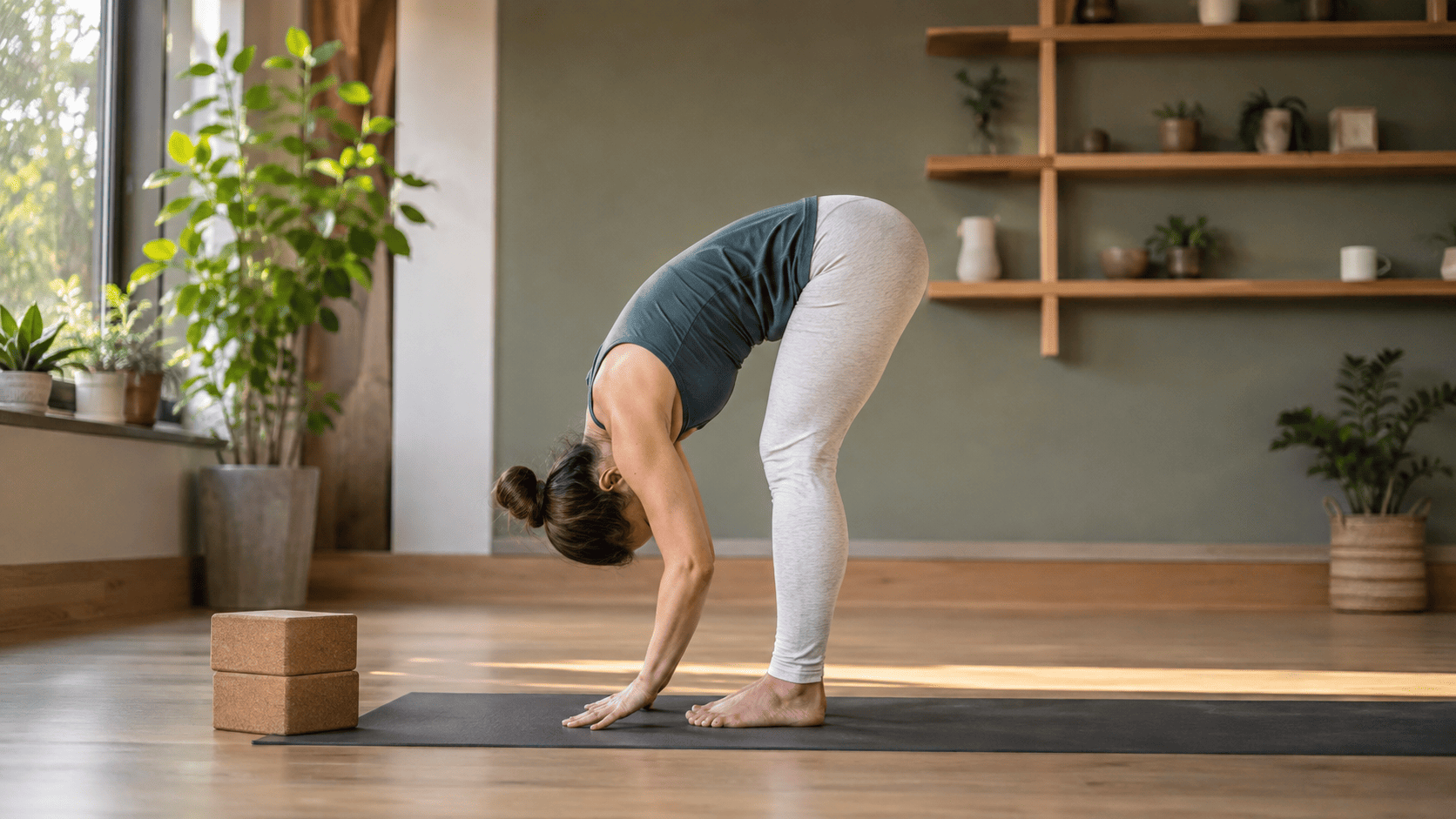
Standing Forward Bend: How To Practice Uttanasana Safely
Standing Forward Bend, also called Standing Forward Fold or Uttanasana, is one of the most recognizable poses in yoga. You will find it in Hatha and Vinyasa practices, Sun Salutations, warmups, and transitions between standing poses.
Although it may look like the goal is to reach your toes, Uttanasana is really an exploration of the hips, legs, spine, breath, and your relationship with sensation. Your knees can bend, your hands can rest on blocks, and your fold does not need to look like anyone else's for the pose to be meaningful.
What Is Standing Forward Bend?
Standing Forward Bend is a yoga posture in which you fold your torso toward your legs from a standing position. Its Sanskrit name, Uttanasana, is commonly translated as an intense stretch pose.
The movement primarily involves hinging from the hip joints while allowing the torso to travel toward the thighs. Depending on your mobility, your hands might reach the floor, rest on blocks, touch your legs, or remain supported by a chair.
Uttanasana is common within Hatha and Vinyasa yoga. If you are interested in understanding foundational poses more deeply, Yoga Farm's Foundations of the Pose program explores the relationship between alignment, movement, and individual bodies.
What Muscles Does Standing Forward Bend Stretch?
Most people notice Standing Forward Bend through the back of the body, particularly the hamstrings. The calves, glutes, muscles surrounding the hips, and tissues along the back may also experience a stretch.
Your legs are not completely passive, however. The feet remain connected to the floor, and the muscles around the thighs and hips can help create stability while you fold.
What you feel will depend on your anatomy, flexibility, stance, knee position, and previous movement experience. A comfortable stretching sensation can be appropriate, but sharp pain, numbness, tingling, or strong pulling is a reason to reduce the depth or come out of the pose.
Benefits Of Standing Forward Bend
Uttanasana can support flexibility through the hamstrings and calves while encouraging greater awareness of the hips and posterior body. Practiced gradually, it may help you become more familiar with the difference between forcing flexibility and allowing movement to develop over time.
The pose can also provide an opportunity to slow down. With your torso folding forward and your breath remaining steady, Standing Forward Bend can become a quiet pause within a more active yoga sequence.
Regular practice may also support:
Awareness of hip movement and the hip hinge
Mobility through the backs of the legs
Greater awareness of weight distribution through the feet
A sense of length through the back body
Body awareness during transitions between standing poses
These benefits do not depend on how close your hands are to the floor.
How To Do Standing Forward Bend
You do not need exceptional flexibility to practice Uttanasana. Begin with a version that allows you to breathe comfortably and remain present.
Stand tall with your feet together or approximately hip width apart.
Feel the weight distributed through both feet.
Inhale and allow your spine to lengthen.
Exhale and soften your knees.
Begin folding from your hip creases rather than trying to collapse through your waist.
Allow your torso to move toward your thighs.
Place your hands on the floor, blocks, shins, or another stable surface.
Let your neck remain comfortable rather than actively pulling your head downward.
Continue breathing while staying for several comfortable breaths.
To come out, bend your knees enough to feel stable. You can lift halfway first, lengthen your spine, and then return gradually to standing. Move slowly if forward folds make you feel lightheaded.
Should Your Knees Be Bent Or Straight?
Your knees do not have to be straight in Standing Forward Bend. In fact, bending them can be one of the most useful ways to make Uttanasana more accessible.
A bend in the knees reduces the demand placed on the hamstrings and may allow your pelvis to move more freely over your thighs. This can be especially helpful if tight hamstrings cause you to strain through your lower back.
Over time, you may choose to straighten the legs more. That progression is optional. Locking the knees or forcing straight legs does not make the pose more advanced or more correct.
This approach reflects the choice centered principles explored through trauma-informed yoga teaching, where variations are part of the practice rather than treated as lesser versions of a pose.
How To Hinge From The Hips
One of the most useful cues for Uttanasana is to fold from the hips rather than simply reaching your head toward your knees.
Place your hands at the front of your hip creases and gently bend your knees. As you begin to fold, imagine your pelvis tipping forward over the tops of your thighs while your torso follows that movement.
Think about moving forward before moving downward. This can help you notice the difference between movement at the hip joints and simply rounding your back to reach closer to the floor.
Standing Forward Bend Modifications
Props can make Uttanasana more supportive without reducing the value of the pose. Bringing support toward your body is often more useful than forcing your body toward the floor.
Use Yoga Blocks
Place one block under each hand. Blocks can be positioned at different heights, allowing you to choose the amount of support that works for your body that day.
Bend Your Knees
Bend your knees as much as necessary to reduce strain through your hamstrings or lower back. Your torso may even rest closer to your thighs.
Use A Chair
Place your hands on the seat or back of a sturdy chair. This decreases the depth of the fold and can provide additional stability.
Widen Your Stance
Your feet do not have to touch. A hip width or slightly wider stance may provide more stability and space through the pelvis.
Accessible variations like these are also an important part of the anatomy, cueing, and teaching skills explored within Yoga Farm's200 hour Hatha and Vinyasa teacher training.
Common Standing Forward Bend Mistakes
The most common challenge in Uttanasana is treating depth as the measure of success. Reaching the floor may happen for some bodies and not for others.
Avoid forcing the pose by locking your knees, pulling your torso downward with your arms, or holding your breath. It is also common to shift all of the body weight toward the heels while trying to fold farther.
Instead, maintain awareness across your feet, soften your knees when needed, and allow the breath to remain available. A smaller fold that feels steady can offer more useful information than a deeper position reached through strain.
Standing Forward Bend For Tight Hamstrings
Tight hamstrings do not prevent you from practicing Uttanasana. They simply influence the version of the posture that may feel appropriate.
Begin by bending your knees and using blocks. Keep your attention on the hip hinge rather than straightening your legs. As your body becomes familiar with the movement, you may notice gradual changes in mobility.
Why Can't I Touch My Toes?
Whether you can touch your toes depends on much more than effort. Hamstring flexibility, hip mobility, limb proportions, previous activity, and individual anatomy can all affect your forward fold.
Touching the toes is not a requirement for practicing Standing Forward Bend correctly. Yoga is not a flexibility test.
Standing Forward Bend And Back Pain
Some people find a gentle, bent knee forward fold comfortable, while others with back conditions may find forward bending aggravating. Uttanasana should not be considered a treatment for back pain.
If you have persistent back pain, a disc condition, a recent injury, or symptoms such as numbness, weakness, or radiating pain, individualized guidance from an appropriate health professional can help determine whether forward bending is suitable for you.
A shallower fold, bent knees, blocks, or a chair may sometimes provide a more comfortable alternative.
Uttanasana Vs Ardha Uttanasana
Uttanasana and Ardha Uttanasana often appear together, but they are different poses.
In Uttanasana, the torso folds toward the legs and the head generally lowers. In Ardha Uttanasana, or Half Standing Forward Bend, the torso lifts away from the thighs as the spine extends forward.
You will often move from Uttanasana into Ardha Uttanasana during a Sun Salutation before transitioning into the next part of the sequence.
Standing Forward Bend In Sun Salutations
Standing Forward Bend is a foundational transition in many Sun Salutation variations. A sequence may move from Mountain Pose into an upward reach, then into Uttanasana, followed by Half Standing Forward Bend.
Because it appears repeatedly in flowing practices, becoming comfortable with modifications can make an entire Vinyasa practice feel more accessible. Students practicing at home can also explore how different formats affect their practice through Yoga Farm's discussion oflive and on-demand yoga classes.
Practicing Standing Forward Bend With Choice
A yoga pose does not have to be performed in one fixed shape. Your body, energy, mobility, balance, and needs can change from one practice to another.
Yoga Farm Ithaca approaches yoga through an inclusive, trauma-informed lens where choice and body awareness are central to the experience. In Uttanasana, that might mean bending your knees today, using blocks tomorrow, or choosing a supported Half Forward Bend when that feels more appropriate.
The invitation is not to achieve the deepest forward fold. It is to notice what happens when movement, breath, attention, and choice meet in the same moment.
Frequently Asked Questions
Is Standing Forward Bend Good For Back Pain?
Standing Forward Bend may feel comfortable for some people, particularly when practiced gently with bent knees, but it can aggravate certain back conditions. If you have persistent or significant back pain, seek individualized guidance before using forward folds as part of your practice.
Who Should Modify Or Avoid Forward Bends?
People with recent back or hamstring injuries, certain spinal conditions, significant dizziness or vertigo, or medical conditions affected by placing the head below the heart may need modifications or professional guidance. Pregnancy can also change how forward bends are practiced as the body changes.
How Do You Do A Standing Forward Bend Correctly?
Stand with stable feet, soften your knees, lengthen your spine, and hinge forward from your hips. Rest your hands wherever they comfortably reach and keep breathing rather than forcing yourself toward the floor.
Should You Bend Your Knees In Standing Forward Bend?
Yes. Bent knees are a valid and often helpful way to practice Uttanasana, particularly for tight hamstrings or when you want more space through the pelvis and lower back.
How Long Should You Hold Uttanasana?
There is no single required duration. Beginners may stay for several comfortable breaths, while some practices include longer holds. Let your breathing and comfort guide the length rather than trying to reach a fixed time.
Is Standing Forward Bend Part Of Sun Salutation?
Yes. Uttanasana appears in many Sun Salutation sequences and is frequently paired with Ardha Uttanasana, or Half Standing Forward Bend.