
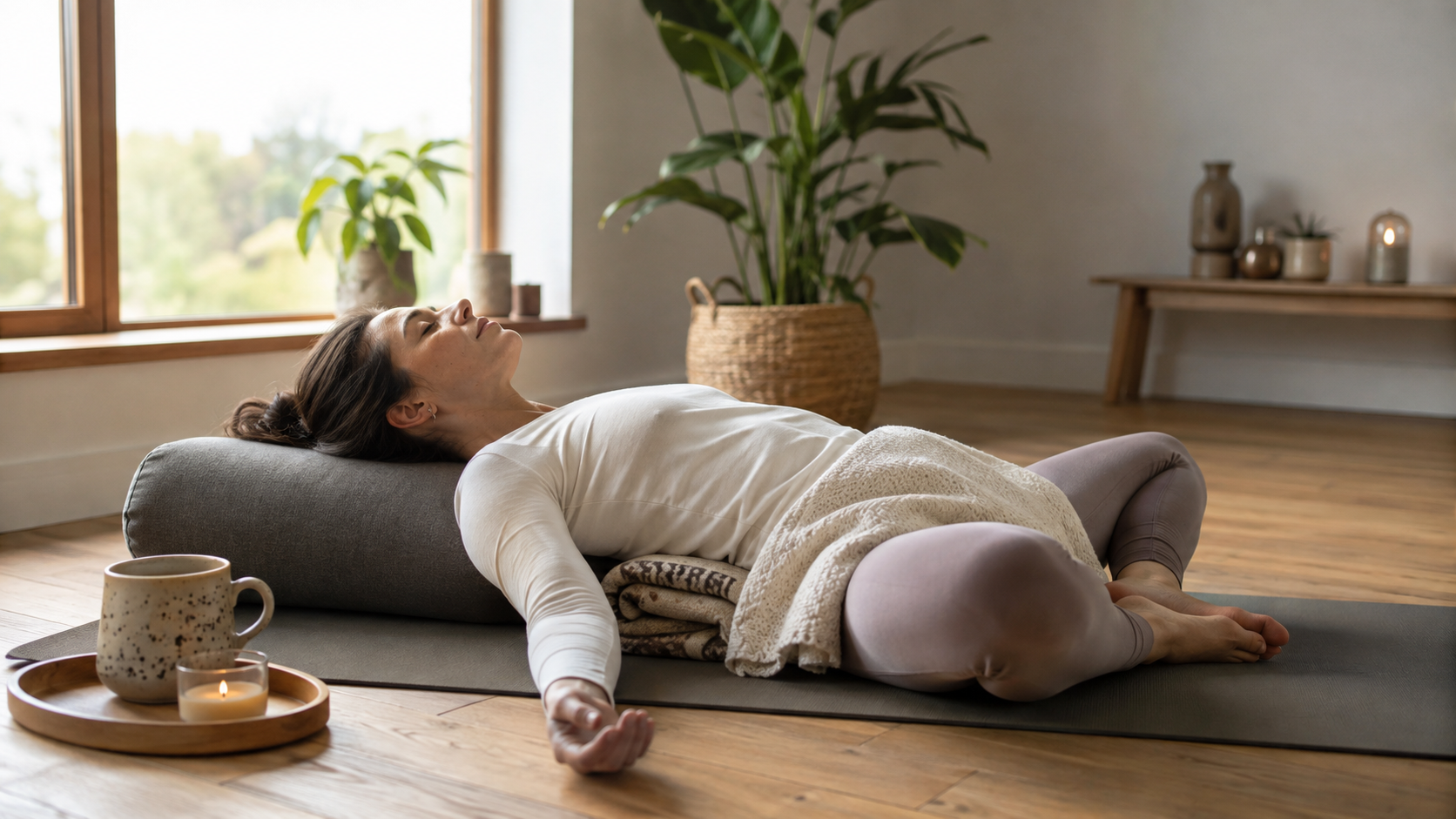
How Yoga Can Support You During Your Period
Some periods arrive with mild discomfort. Others bring cramps, lower back tension, bloating, fatigue, mood changes, or a strong desire to curl up somewhere warm and be left alone. Your needs can also change from one cycle to the next.
Yoga during your period does not need to mean completing a full flow or pushing through discomfort. A few gentle movements, supported positions, quiet breathing, or intentional rest can all be part of the practice. The goal is not to make your body perform. It is to notice what your body is asking for and respond with care.
Is It Good To Do Yoga During Your Period?
For most people, gentle yoga can be practiced during menstruation when it feels comfortable. Research on exercise and primary dysmenorrhea, the medical term for common menstrual pain without another underlying condition, suggests regular movement interventions including yoga may help reduce menstrual pain over time.
That does not mean you need to practice every time you have your period. If you are tired, uncomfortable, dizzy, or simply do not feel like moving, rest is a completely valid choice.
Think of period yoga as an adaptable practice rather than a fixed sequence. On one day, gentle movement might feel nourishing. On another, lying over a bolster and breathing quietly may be enough.
What Happens In Your Body During Your Period?
Menstrual cramps happen as the uterus contracts to help shed its lining. These contractions are influenced by substances called prostaglandins and can create discomfort in the lower abdomen, back, pelvis, and sometimes the thighs.
Cramps are only one possible experience. Menstruation can also come with fatigue, headaches, digestive changes, bloating, lower back soreness, and shifts in mood or energy.
Rather than treating these sensations as obstacles to practice, yoga can become a way to adjust your movement to how you actually feel.
How Yoga May Support You During Your Period
Yoga cannot promise to eliminate menstrual symptoms, and severe period pain deserves proper medical attention. For everyday discomfort, however, gentle movement and relaxation may offer meaningful support.
May Ease Menstrual Cramps
A slower yoga practice combines movement with periods of relaxation, which may help some people feel more comfortable during menstruation. The available research suggests yoga can reduce menstrual pain for some people, particularly when practiced regularly rather than used as a one time fix.
There is no need to stretch deeply to receive that support. Small movements through the pelvis and spine can be enough.
May Release Lower Back And Hip Tension
Period discomfort often extends beyond the abdomen. Your lower back, hips, and pelvic area may also feel tight, heavy, or sensitive.
Gentle positions that allow these areas to soften can feel more supportive than forcing flexibility. If you usually enjoy a stronger Vinyasa yoga practice, your period may be an invitation to slow the pace and reduce intensity.
Can Create Space For Rest And Regulation
Yoga also includes breathing, stillness, body awareness, and rest. These quieter elements can be especially useful when your energy is low or your nervous system feels more sensitive.
A supportive practice does not ask you to ignore discomfort. It gives you options for meeting it differently.
7 Gentle Yoga Poses For Your Period
There is no single best yoga pose for menstruation. Start with positions that feel spacious and easy to leave whenever you want.
Supported Child's Pose
Bring your knees to a comfortable width and rest your torso over a bolster, pillow, or folded blankets. Allow your arms to relax wherever they feel natural.
This position can provide a sense of support through the back and hips. If folding forward creates abdominal pressure, raise the support beneath your torso or choose another pose.
Reclined Bound Angle Pose
Lie on your back, bring the soles of your feet together, and allow your knees to open outward. Place pillows or blocks beneath your thighs so the hips do not have to work to hold the position.
Supta Baddha Konasana can be particularly useful when what you want most is stillness rather than stretching.
Cat-Cow Pose
Come onto hands and knees and slowly move your spine between a gentle arch and rounded position. Let the movement be small enough that you can continue breathing comfortably.
Cat-Cow offers movement through the spine and pelvis without requiring a demanding sequence.
Knees-To-Chest Pose
Lie on your back and bring one or both knees toward your torso. Hold behind your thighs if pulling the knees close to your abdomen feels uncomfortable.
You can remain still or make tiny rocking movements if they feel soothing.
Gentle Supine Twist
From your back, allow bent knees to move toward one side while keeping the twist soft. A pillow beneath the knees can reduce the amount of rotation.
Twisting should not feel like compression. If pressure or pain increases, come back to center.
Legs-Up-The-Wall
Rest on your back with your legs supported against a wall, headboard, couch, or chair. The setup should feel restful rather than like something you need to hold.
If this position creates pelvic pressure or simply does not feel good during your period, skip it.
Supported Savasana
Sometimes the most useful pose is the one where nothing is required of you. Lie down with a bolster under your knees, cover yourself with a blanket, and allow your body to settle.
Savasana is not what happens after the practice. It is a practice in itself.
Try A Simple 10-Minute Period Yoga Practice
A short practice can begin with two minutes in Supported Child's Pose, followed by several slow rounds of Cat-Cow. Move onto your back for Knees-To-Chest and a gentle twist on each side, then finish with Reclined Bound Angle or Supported Savasana.
Ten minutes is not a rule. You might spend all ten minutes in one restorative position, move for five minutes, or decide that today your practice is simply resting.
If you want more structure without committing to an intense class, Yoga Farm's online yoga and meditation membership includes practices that can be adapted to changing energy levels.
How To Match Yoga To Your Period Symptoms
A useful period practice begins with the symptom you are actually experiencing rather than a prescribed list of poses.
For cramps: Try supported floor poses, gentle pelvic movement, and slow breathing.
For lower back tension: Explore Child's Pose, Cat-Cow, or Knees-To-Chest.
For bloating: Keep movement spacious and avoid positions that create uncomfortable abdominal compression.
For fatigue: Choose restorative poses, Savasana, or rest completely.
For irritability or stress: Slow the pace and spend more time breathing or lying down.
For heavy flow: Keep the practice comfortable and low effort, particularly if you also feel weak or lightheaded.
The same symptoms can also feel different from month to month. Checking in before and during practice is more useful than deciding in advance what you "should" be able to do.
Which Yoga Should Not Be Done During Your Period?
You may have encountered rigid lists saying certain poses should never be practiced while menstruating. A more useful approach is to distinguish traditional yoga recommendations from what your individual body needs.
Some traditions discourage inversions during menstruation. That does not mean everyone needs to follow a universal medical prohibition. If Headstand, Handstand, or another demanding inversion feels uncomfortable, tiring, or unfamiliar, there is no reason to force it.
The same applies to deep twists, strong backbends, intense core work, power yoga, and hot yoga. Menstruation itself does not require everyone to avoid these practices, but increased cramps, fatigue, dizziness, or abdominal sensitivity may make a gentler option feel better.
Your practice can change without becoming less meaningful.
Can You Do Yoga On The First Day Of Your Period?
Yes, if yoga feels supportive to you. For some people, the first day brings their strongest cramps and lowest energy. Others notice little difference in how they feel.
Instead of following a rule based on the calendar, choose according to your symptoms. Gentle movement, supported yoga, breathing, or complete rest are all legitimate forms of practice.
Yoga Farm's approach to trauma-sensitive yoga centers choice and agency, principles that are particularly relevant when the body is asking for something different than usual.
When Period Pain Deserves Medical Attention
Yoga can support comfort, but it should not be used to normalize pain or bleeding that is significantly affecting your life.
ACOG distinguishes primary dysmenorrhea from secondary dysmenorrhea, where period pain can be related to conditions such as endometriosis, fibroids, or other reproductive health concerns. Consider speaking with a healthcare professional if:
Your pain prevents you from working, attending school, sleeping, or completing normal activities.
Your periods suddenly become substantially more painful, heavy, or irregular.
You regularly experience significant dizziness or fainting.
You bleed between periods.
You have pelvic pain outside your period.
You experience pain during sex or when urinating or having a bowel movement.
These are reasons to seek individualized care rather than trying to manage everything through yoga.
A Choice-Based Approach To Period Yoga
Yoga Farm's approach to practice is rooted in adaptability, choice, and awareness rather than forcing every body into the same experience.
That means props are welcome. Rest is welcome. Changing your mind halfway through a pose is welcome. Some days may call for active movement, while others may feel better with breathwork, restorative shapes, or quiet.
Local students can explore that same approach through Ithaca studio classes, where practices include yoga, Qigong, meditation, and other body aware offerings.
Your period does not need to become another time when you measure yourself by productivity. Yoga can instead become an opportunity to pay closer attention to sensation, energy, and choice.
Frequently Asked Questions
Is It A Good Idea To Do Yoga On Your Period?
Gentle yoga can be a supportive option during menstruation if it feels comfortable. Research suggests regular yoga and other forms of exercise may help reduce primary menstrual pain, although individual experiences vary.
What Yoga Can I Do During Periods?
Restorative yoga, gentle Hatha, somatic movement, Cat-Cow, Supported Child's Pose, Reclined Bound Angle, easy twists, and Savasana are all options. Choose poses based on comfort rather than trying to complete a specific period sequence.
Which Yoga Should Not Be Done During Periods?
There is no need to force demanding poses while menstruating. Skip or modify any inversion, twist, backbend, core exercise, or heated practice that increases pain, dizziness, pressure, nausea, or fatigue.
Does Yoga Help With Period Cramps?
Research suggests yoga may help reduce pain associated with primary dysmenorrhea, particularly as part of a regular practice. It should be viewed as supportive care rather than a substitute for medical evaluation when period pain is severe or changing.
What Is The 7-2-1 Rule For Menstruation?
The 7-2-1 rule is a simple way of recognizing potentially heavy menstrual bleeding. It refers to periods lasting more than seven days, needing to change a pad or tampon more often than every two hours, or passing more than one quarter-sized clot in a cycle. It is not a yoga rule.
Let Your Practice Meet You Where You Are
Yoga during your period is not about finding the perfect pose for cramps or following a strict set of menstrual rules. It is about noticing your energy, sensations, comfort, and capacity on that particular day.
Sometimes movement feels wonderful. Sometimes the most supportive practice is a blanket, a bolster, and a few quiet breaths. Both belong in yoga.