
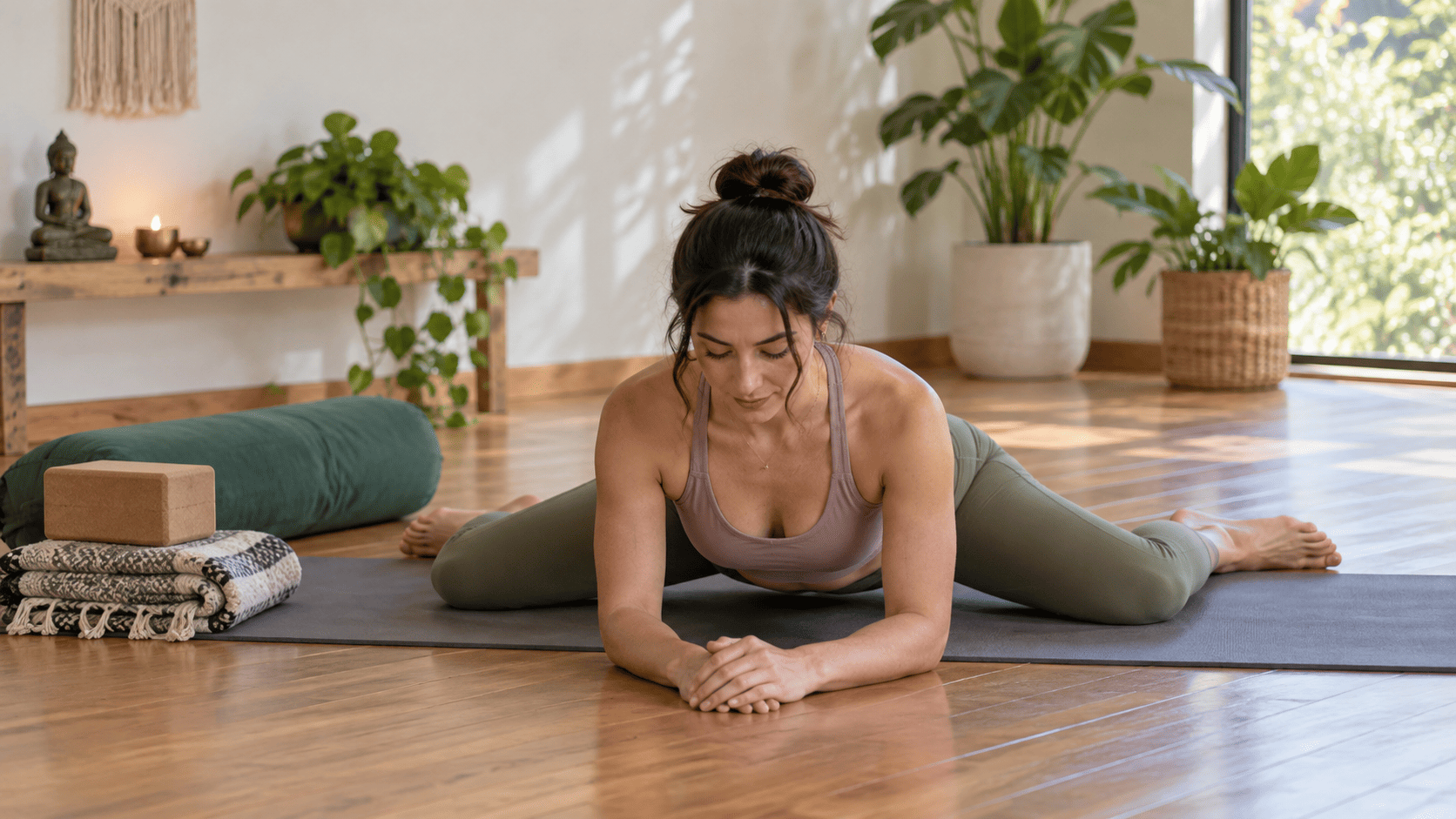
Frog Pose: Benefits, How To Do It, And Modifications
Frog Pose is one of those yoga postures that can look simple from across the room and feel completely different once you are in it. With the knees wide and the body supported close to the floor, the pose creates a strong stretch through the inner thighs and hips.
Often called Mandukasana in modern yoga classes, Frog Pose can be useful for exploring hip mobility, slowing down, and paying closer attention to sensation. It is also a posture where more depth is not necessarily better. A supported version with steady breathing can be far more useful than trying to push the knees as wide as possible.
Whether you are new to yoga or already have an established practice, approaching Frog Pose with patience and choice can help make it more comfortable and sustainable.
What Is a Frog Pose?
Frog Pose is a floor based hip opening posture in which the knees move apart while the lower legs extend outward. The upper body may stay supported on the hands, forearms, blocks, or a bolster depending on your mobility and comfort.
You will often see this version called Mandukasana, although yoga terminology can vary between traditions. Some schools use Mandukasana for a different kneeling posture, while Bhekasana is another pose translated as Frog Pose that involves lying on the belly and holding the feet.
For this article, Frog Pose refers to the familiar wide knee hip opener commonly practiced in Hatha, Vinyasa, and Yin yoga.
What Muscles Does Frog Pose Stretch?
Frog Pose primarily creates length through the adductors, the group of muscles along the inner thighs that help bring the legs toward the center of the body.
Depending on your individual anatomy, you may also notice sensation around the groin, hips, pelvis, and surrounding connective tissues. The pose places the hips in a wide position, so every person's version will look a little different.
The goal is not to make your body match a photograph. The goal is to find a position where you can feel a useful stretch while continuing to breathe without sharpness, pinching, or strain.
Frog Pose Benefits
Frog Pose is most useful as a mobility and awareness practice rather than something you need to achieve. Its benefits depend on how the pose is practiced and what your body needs that day.
Supports Hip And Inner Thigh Mobility
The wide knee position gives the inner thighs a chance to lengthen gradually. This can feel particularly useful for people who spend long periods sitting or whose movement routine does not often include wide hip positions.
Improving comfortable range of motion around the hips may also support everyday movements such as squatting, walking, getting down to the floor, and moving between yoga postures.
Encourages Slower, More Intentional Movement
Frog Pose is difficult to rush. Entering too quickly usually creates unnecessary intensity, so the posture naturally encourages slower movement and closer attention to physical sensation.
That same internal awareness is central to somatic yoga, where the focus is less on achieving an external shape and more on noticing how movement actually feels from within.
Creates Space For Mindful Breathing
Once supported comfortably, Frog Pose can become a place to practice steady breathing. Instead of using the breath to tolerate discomfort, use it as feedback.
If your breathing becomes tight, shallow, or difficult, consider reducing the intensity. A few simple yoga breathing techniques can also help you stay connected to your body without turning the posture into an endurance test.
How To Do Frog Pose
Give yourself enough space and use a padded mat. If your knees are sensitive, place a folded blanket beneath them before beginning.
Start on your hands and knees in a tabletop position.
Slowly move your knees farther apart. Pause before the stretch becomes intense.
Allow your lower legs to extend outward so your ankles are approximately in line with your knees, if that position feels comfortable.
Keep your hands on the floor or lower onto your forearms. Blocks beneath your forearms can bring the floor closer.
Gently move your hips backward until you notice a stretch through the inner thighs.
Keep the spine relatively long without forcing the lower back into a deep arch.
Breathe slowly and stay only as long as you can maintain a manageable sensation.
To come out, press through your hands, bring your torso upright, and gradually move your knees toward one another.
Move slowly when leaving the pose. After a longer hold, the inner thighs may feel temporarily sensitive.
Where Should You Feel Frog Pose?
Most people feel Frog Pose through the inner thighs and groin. You might also notice a broad stretching sensation around the hips.
What you should not feel is sharp pain, pinching inside the hip joint, numbness, tingling, or strong pressure in the knees. Those sensations are good reasons to change your position or come out.
Yoga does not require you to ignore discomfort. Responding to your body is part of the practice.
Frog Pose Modifications For Beginners
You do not need exceptionally flexible hips to explore Frog Pose. In fact, modifying the posture often makes it more useful.
Try one or more of these options:
Keep your knees closer together rather than moving toward your maximum range.
Place folded blankets beneath the knees for cushioning.
Stay on your hands instead of lowering to the forearms.
Support your forearms on yoga blocks.
Place a bolster beneath your chest or torso.
Hold the pose for several breaths rather than several minutes.
A modification is not a lesser version of the posture. It is simply another way of organizing the pose around the body practicing it.
How Long Should You Hold Frog Pose?
Beginners may start with approximately 20 to 30 seconds, or simply several comfortable breaths. As the position becomes familiar, you might stay for 30 to 90 seconds.
Longer holds are sometimes used in Yin yoga, but duration should never replace good judgment. If the sensation becomes sharper or the knees begin to feel stressed, come out.
In a flowing Vinyasa yoga practice, Frog Pose may be held for a shorter period after other movements have already warmed the hips and legs.
How To Prepare For Frog Pose
Frog Pose usually feels better when the body has moved first. Going directly from sitting at a desk into a deep hip stretch can make the posture feel unnecessarily intense.
Try preparing with gentle movements such as:
Cat Cow
Hip circles from tabletop
Wide Knee Child's Pose
Low Lunge
Butterfly Pose
Gentle squats
The purpose of preparation is not to force the hips open. It is simply to introduce movement gradually before asking the inner thighs to work in a larger range.
Common Frog Pose Mistakes
One of the most common mistakes is assuming that wider knees mean a better pose. Your useful range ends well before pain.
Another common issue is lowering the torso simply because everyone else in class is doing so. Staying on your hands may actually give you better control over your hips.
Watch for these patterns:
Sliding the knees wider after your body has already said enough
Holding your breath to tolerate the stretch
Allowing strong pressure to build in the knees
Forcing the feet into a particular angle
Arching the lower back excessively
Trying to stay for a predetermined amount of time
Think of Frog Pose as exploration rather than achievement.
Frog Pose In Yin Yoga
Frog is popular in Yin yoga because the supported shape can be held relatively still while the practitioner observes sensation over time.
In a Yin setting, props become especially useful. A bolster beneath the torso or blankets beneath the knees can reduce muscular effort and make it easier to stay without forcing.
Longer does not automatically mean deeper or more beneficial. Your body may respond differently from one practice to another, so treat time as an option rather than a requirement.
Frog Pose Vs Bhekasana
The name Frog Pose can cause confusion because it describes more than one yoga posture.
The wide knee hip opener discussed here is commonly called Mandukasana in modern classes. Bhekasana, also translated as Frog Pose, is a different posture. In Bhekasana, you lie on your belly, bend the knees, reach backward toward the feet, and work more strongly with the quadriceps, shoulders, and backbend.
If you are following instructions online, look at the body position rather than relying only on the Sanskrit or English name.
Who Should Be Careful With Frog Pose?
Anyone experiencing current knee, groin, hip, or significant lower back pain should approach Frog Pose carefully. A recent injury or surgery may also make the posture inappropriate until a qualified healthcare professional has cleared movement.
Pregnancy can change joint mobility and comfort, so prenatal yoga should be adapted to the individual and stage of pregnancy rather than following a standard Frog Pose setup.
Most importantly, pain is not evidence that a stretch is working. Strong stretching sensations and joint pain are not the same thing.
A More Choice Based Approach To Yoga
Yoga becomes more sustainable when the posture serves the practitioner rather than the practitioner trying to serve the posture.
Yoga Farm Ithaca teaches with choice based, trauma informed language that encourages students to work with their own bodies, boundaries, and experiences. Within the Radiant Warrior training, students explore common yoga poses alongside anatomy, accessibility, modifications, sequencing, mindfulness, and consent based teaching practices.
For people interested in developing a broader foundation for practice or teaching, Yoga Farm's online yoga teacher training pathways combine embodied practice with live support, adaptable learning, and community centered education.
Frog Pose can be part of that process. The meaningful question is not how wide your knees can go. It is whether you can remain curious, breathe, respond to sensation, and make choices that support your body.
Frequently Asked Questions About Frog Pose
Is Frog Pose Good For Beginners?
Beginners can practice Frog Pose, but the full expression can be intense. Keep the knees closer together, stay supported on the hands, use blankets beneath the knees, and begin with short holds.
Why Is Frog Pose So Difficult?
Frog Pose places the hips in a wide position while stretching the inner thigh muscles. If that range is unfamiliar to your body, the sensation can become strong quickly. Individual hip anatomy also influences how the posture looks and feels.
How Long Should You Stay In Frog Pose?
Start with several slow breaths or around 20 to 30 seconds. Longer holds may be appropriate once you understand how your body responds, but there is no required duration.
Is Frog Pose Supposed To Hurt?
No. A stretching sensation through the inner thighs can be expected, but sharp pain, joint pressure, pinching, numbness, or tingling are reasons to reduce the intensity or leave the posture.
Does Frog Pose Open Tight Hips?
Frog Pose can help explore mobility through the hips and inner thighs when practiced consistently and without forcing. One posture will not permanently change hip mobility by itself, so it is best included within a balanced movement practice.
Is Frog Pose The Same As Mandukasana?
The wide knee version is commonly called Mandukasana in modern yoga, but terminology varies between traditions. Some traditions use Mandukasana for another kneeling posture, while Bhekasana is also translated as Frog Pose.
Can I Do Frog Pose Every Day?
Some people may comfortably include a gentle version regularly, while others need more recovery between deeper hip stretches. Let your current range, soreness, and joint comfort determine how often you practice rather than following a fixed schedule.